
You open your dashboard and see 40,000 followers. Feels great, right? Then you check sales. Nothing moved.
That gap is why the bouncemediagroup.com social stat conversation matters. It’s not about collecting big numbers. It’s about knowing which ones actually mean something.
Let’s walk through it like we’re chatting over coffee.
What Is the Bouncemediagroup.com Social Stat, Really?
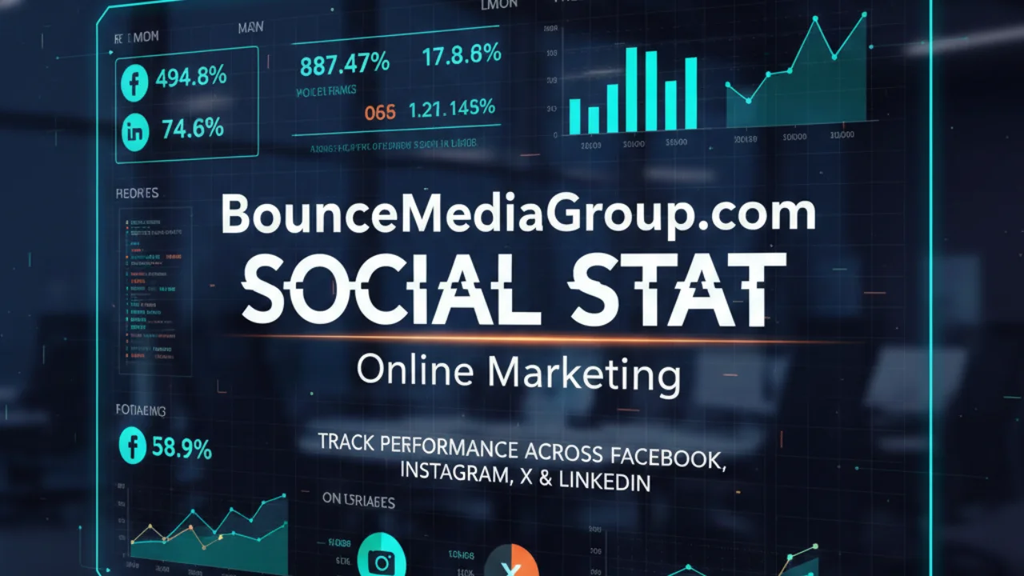
Most pages online describe it the same way: social-media performance information tied to BounceMediaGroup.com, covering audience reach, engagement, follower growth, impressions, video performance, referral traffic, and conversions. tycoonstory
So it’s not one magic number. It’s a bundle of signals that show how a brand performs across social platforms.
Think of it like a car dashboard. Speed, fuel, engine temperature. One gauge alone won’t tell you if the trip is going well.
The site also runs a dedicated Social Stats section. According to one write-up, it covers reach, engagement, growth, audience loyalty, referral traffic, social discovery, and checking public stats for accuracy. tycoonstory
Why the Bouncemediagroup.com Social Stat Matters for Your Strategy

Here’s the honest answer: guessing is expensive.
Without stats, you post what feels right. With them, you post what actually works. That’s a big difference over six months.
A good social stat habit helps you:
- Spot which platforms deserve your time
- Stop wasting hours on content nobody sees
- Prove to your boss or client that social media pays off
- Catch problems early, like a sudden drop in reach
And it’s not just for big brands. A solo creator benefits just as much.
The Core Metrics Behind Bouncemediagroup.com Social Stat
Let’s break the main ones down. No jargon, promise.
Reach and Impressions
Reach is how many different people saw your content. Impressions are how many times it was seen, including repeat views.
Say 1,000 people see your post, and each sees it twice. Reach is 1,000. Impressions are 2,000.
Why care? If impressions are far higher than reach, the same small group keeps seeing you. That’s fine for loyalty. It’s not great for growth.
Engagement
Likes, comments, shares, saves, clicks. This is the “did anyone care?” metric.
A simple formula many marketers use:
Engagement rate = (total interactions ÷ followers) × 100
Some people divide by reach instead. Both work. Just pick one and stay consistent.
Quick tip: comments and saves usually say more than likes. A like takes half a second. A save means “I want this later.”
Follower Growth
Growth is nice. But steady growth beats a sudden spike.
If you jump by 5,000 followers overnight and then drop by 3,000, something was off. Maybe a giveaway attracted people who didn’t care about your niche.
Watch the trend line, not the single day.
Referral Traffic and Conversions
This is where social meets money.
Referral traffic is the number of people who click from social to your website. Conversions are what they do next: sign up, buy, download, book a call.
Plenty of accounts have huge reach and almost zero conversions. Don’t be that account.
How to Read the Bouncemediagroup.com Social Stat Without Fooling Yourself
Numbers lie sometimes. Not on purpose. But they can mislead if you read them badly.
Compare Like With Like
Don’t compare a Monday post to a Saturday post. Don’t compare a video to a plain text update.
Compare similar content, same format, similar time. That’s how patterns show up.
Look at Ratios, Not Raw Totals
10,000 followers with 800 engaged people is healthier than 100,000 followers with 400 engaged people. Always.
Give It Time
One week of data is a snapshot. Four to eight weeks starts to look like a story.
Ask “So What?”
Every number needs an action attached. Reach dropped 20%? Okay. What changed? Posting time? Format? An algorithm tweak?
If a stat doesn’t change what you do next, it’s trivia.
Can You Trust Public Social Stats?
Good question. And one worth asking.
Public numbers can be inflated. Bought followers, engagement pods, and bot comments are all real things. Some of the pages covering this topic also stress methods for verifying public numbers, which is smart. tycoonstory
Here’s a quick checklist for sanity-checking any account’s stats:
- Check the comments. Are they real sentences, or just “Nice!” and emojis from random accounts?
- Compare followers to engagement. A giant following with tiny interaction is a red flag.
- Look at growth history. Sudden cliffs and spikes deserve a second look.
- Cross-check with other sources. Don’t rely on one tool or one page.
- Check the audience location. If a local business has most followers overseas, ask why.
One more thing. Many pages online repeat each other and don’t share their original data. A small note on one of them even warns that the website’s availability and content may have changed since the information was gathered. So treat any third-party stat as a clue, not gospel. univille
A Real-World Scenario
Let’s say you run a small online bakery. You post on Instagram, TikTok, and Facebook.
After a month, you check your stats:
- Instagram: Moderate reach, strong saves on recipe carousels
- TikTok: Huge views, almost no website clicks
- Facebook: Low reach, but the few clicks mostly turn into orders
What would you do?
Most people chase the TikTok views. But the stats say Facebook converts, and Instagram builds a loyal audience. So you might keep TikTok for awareness, double down on Instagram carousels, and run small Facebook promos.
That’s the power of reading your social stat properly. It points you to where the money is, not just where the applause is.
How to Build Your Own Social Stat Routine
You don’t need fancy software on day one. Here’s a simple routine.
- Pick three to five core metrics. Reach, engagement rate, follower growth, link clicks, conversions. That’s plenty.
- Set a baseline. Write down your current numbers before changing anything.
- Check weekly, review monthly. Weekly for quick fixes. Monthly for real decisions.
- Track content types. Tag posts as video, image, carousel, text. Then see which wins.
- Test one thing at a time. Change the posting time or the caption style. Not both.
- Write short notes. “Posted at 7pm, got 3x saves.” Future you will be grateful.
For tools, free native analytics on each platform work fine to start. If you want everything in one place, tools like Hootsuite or Buffer are popular choices.
Common Mistakes People Make With Social Stats
Let’s save you some pain.
- Chasing vanity metrics. Followers and likes feel good but rarely pay bills.
- Ignoring the audience. Age, location, and active hours shape everything.
- Copying competitors blindly. Their audience isn’t yours.
- Checking daily and panicking. Daily dips are normal. Don’t overreact.
- Never connecting stats to goals. If you don’t know what success looks like, every number looks fine.
Where Social Stats Are Heading
Analytics tools keep getting smarter. More platforms offer built-in insights, and AI features can now summarize your performance in plain language.
But the basics won’t change. You still need to know who’s seeing you, who cares, and who acts.
Tools can calculate. You still have to decide.
Final Thoughts
The bouncemediagroup.com social stat idea comes down to one simple habit: look at your numbers with curiosity instead of ego.
Don’t ask “How big am I?” Ask “What are people telling me through what they do?”
Because behind every chart is a real person who stopped scrolling, or didn’t. And the brands that keep listening to those people tend to be the ones that last.
FAQs
What is the bouncemediagroup.com social stat?
It’s a general term for social media performance data linked to BounceMediaGroup.com. That usually means reach, impressions, engagement, follower growth, referral traffic, and conversions. It isn’t one single number. It’s a set of signals that show how a brand is doing across platforms.
Which social stats matter most?
It depends on your goal. If you want awareness, watch reach and impressions. If you want a loyal audience, look at engagement, saves, and comments. If you want sales, focus on link clicks and conversions.
How often should I check my social stats?
Weekly for quick tweaks, monthly for bigger decisions. Checking daily usually just leads to panic over normal ups and downs.
What’s a good engagement rate?
There’s no single magic number. It changes by platform, industry, and account size. The better question is whether your rate is improving compared to your own past results.
How can I tell if public social stats are fake?
Check the comments for real, relevant replies. Compare followers to engagement. Look for sudden spikes or drops in growth. And never trust a single source on its own.
Are follower counts the most important metric?
Not really. Followers show size, but engagement and conversions show impact. An account with fewer followers and a highly active audience often beats a bigger, quieter one.
Do I need paid tools to track social stats?
No. Free built-in analytics on Instagram, Facebook, TikTok, and LinkedIn cover the basics. Paid tools like Hootsuite or Buffer help when you want everything in one dashboard.